Learning to See in the Dark
One of my favorite painters is Ad Reinhardt. In the final decade of his life, Reinhardt devoted himself to what he called his “black paintings.” At first glance, they appear entirely black. They now hang in places like the Museum of Modern Art and the Tate Modern, quietly waiting for those willing to linger. But he was never really painting “just black.”
If you stay with one of these paintings—long enough for your eyes to adjust and your mind to settle—something begins to emerge. Faint squares within squares. Subtle shifts of color: black touched with red, or blue, or green. Nothing reveals itself quickly. It takes patience.
I’ve come to recognize something similar in my own life, especially in periods of depression. At first, everything feels flat. Heavy. Undifferentiated. My instinct is to turn away—to distract, to fix, to escape. But Reinhardt’s work gently asks something else of me: to stay. To look again.
And this feels especially true right now. We are living through a kind of shared darkness—the violence and suffering unfolding in the Middle East, and an economy that continues to weigh heavily on the middle class and the working poor. It’s easy to feel overwhelmed, to shut down, to look away.
But what if, even here, we are invited to a different kind of seeing? Not passive acceptance, and not indifference, but a steady, courageous presence—the kind that allows us to remain human in the face of what is painful and complex, the kind that keeps the heart from hardening.
When I stay—whether with a painting, my own inner life, or the state of the world—I begin, however faintly, to notice texture. Nuance. The possibility that even within darkness, something else is present.
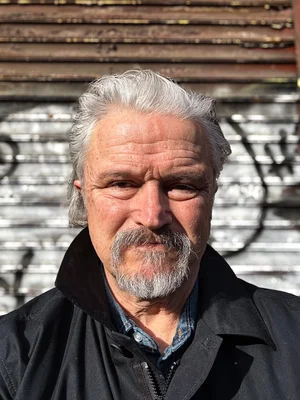
I’m reminded of a photograph I chose to accompany this piece. Every time I go to visit my son, Jon, in Brooklyn, we inevitably find ourselves in a small movie house somewhere in lower Manhattan, watching a film he has recommended. On one occasion, the theater was nearly empty—just the two of us and one older gentleman seated a few rows ahead. As the room dimmed into darkness, I found myself wondering about him. What had brought him there? What was unfolding within him as he sat alone before the screen? What colors—hidden in the darkness, in the interplay between darkness and shadow—were quietly revealing themselves in that moment?
I find myself hoping that one day Jon and I might stand together before one of Reinhardt’s black paintings. He is, in many ways, more courageous and fearless than I am, and I would love to see what he sees—what reveals itself to him—as he lingers there, unafraid, in the depth of Reinhardt’s darkness. Perhaps, standing beside him, I might learn to see a little more clearly myself.
Reinhardt’s black paintings do not offer easy answers. But they do offer this quiet encouragement: do not turn away too quickly. Stay. Look again. There is more here than you think—and that “more,” however subtle, however slow to appear, makes all the difference.